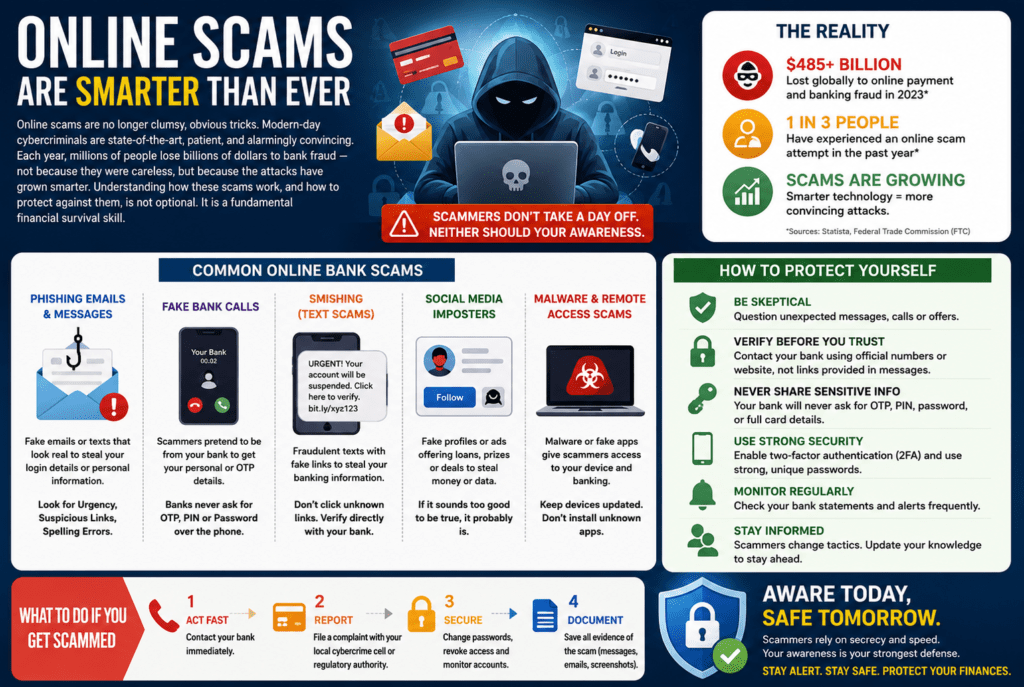
Online scams are no longer clumsy, apparent tricks. Modern-day cybercriminals are state-of-the-art, patient, and alarmingly convincing. Each yr, millions of people lose billions of bucks to financial institution fraud — not because they have been careless, but due to the fact the assaults have grown smarter. Understanding how those scams work and a way to shield against them is not optional. It is a fundamental financial survival talent.
Recognise what you’re up to
Before you can protect yourself, you need to understand the panorama. Online banking scams usually fall into a few well-worn categories:
Phishing is the most common. You get hold of an email, text, or social media message that looks as if it is from your bank, urging you to click on a link and verify your account. The link results in a fake website designed to scouse borrow your login credentials.
Dishing (voice phishing) involves a smartphone call from a person impersonating a financial institution consultant, tax authority, or technical guide agent. They create a feel of urgency — your account has been compromised, you owe a satisfactory amount, your card has been flagged — and push you to show sensitive statistics or transfer budget.
SIM swapping is more technical. A crook contacts your cell provider, pretending to be you, and convinces them to transfer your smartphone’s wide variety to a brand new SIM card. After they manage your number, they are able to intercept the one-time passwords your financial institution sends you.
Malware and key loggers are hidden programs set up in your device, frequently thru infected email attachments or malicious downloads, that record your keystrokes and send your banking credentials to attackers.
Guy-in-the-middle assaults intercept conversation between you and your financial institution, usually over unsecured public wi-fi, capturing statistics as it travels.
Support Your Login Defenses
Your first line of protection is your account getting access to itself.
Use a sturdy, specific password for each financial account. A strong password is long (at least 14 characters), random, and carries a mix of letters, numbers, and symbols. Never reuse a banking password everywhere else. If one website is breached, criminals try to steal credentials everywhere — a process known as credential stuffing.
A password manager makes this possible. It generates and stores complex passwords for you, so that you handiest want to remember one master password.
Enable two-element authentication (2FA) on all your banking and financial accounts. This provides a 2d verification step — generally a code sent to your telephone or generated with the aid of an authenticator app — just so that a person steals your password, they though can’t get in. Authenticator apps (like Google Authenticator or Aunty) are more cozy than SMS-based codes, because text messages can be intercepted or redirected through SIM swapping.
Apprehend and resist Phishing attempts
Phishing succeeds because it mimics what is agreeable. right here is the way to see thru it:
Sluggish down while urgency spikes. Scammers intentionally create panic — “Your account will be suspended in 24 hours!” When strain mounts, treat it as a pink flag.
Check out the sender carefully. A phishing email may come from aid@bankofamerica-relaxed.net instead of @bankofamerica.com. Study the actual email address, not just the display name.
By no means click on links in unsolicited messages. in case you get hold of an email claiming to be from your bank, go immediately for your financial institution’s internet site with the aid of typing the address in your browser, or dial the number on the back of your card. Do not use the contact information supplied in the suspicious message.
Test the URL before entering credentials. Fake websites regularly use URLs that look nearly right — a mild misspelling, a further hyphen, an exclusive domain extension. Search for HTTPS and a padlock icon, but do not rely upon them by myself; rip-off sites can have an SSL certificate too.
Monitor Your Accounts Actively
Detection is as critical as prevention.
most banks offer SMS or email notifications. If something surprising seems, you may recognise it immediately instead of discovering the loss weeks later.
Evaluate your statements frequently — weekly, if possible. search for small, unfamiliar charges. Fraudsters regularly test stolen card information with tiny transactions before making large withdrawals.
Take a look at your credit score record periodically. Unexplained new accounts or inquiries can signal that someone is trying to open credit for your call using your non-public records.
Cozy your gadgets and network
Your tool is the gateway to your monetary life. guard it accordingly.
Maintain your running device, browser, and apps updated. Delaying them leaves recognized gaps open.
Deploy legitimate antivirus and anti-malware software and maintain it in a modern-day. Run regular scans to capture threats earlier than they cause harm.
Keep away from banking on public wireless. coffee shops, airports, and lodges offer comfort, but their networks are looking grounds for Guy-in-the-Middle assaults. If you need to access your account on the go, use your cell phone’s Wi-Fi connection or a VPN.
Lock your gadgets with a PIN, password, or biometric authentication. In case your phone is misplaced or stolen, a lock screen is the first barrier between a thief and your banking apps.
Be cautious with personal information
Scammers regularly combine records from a couple of resources to build a convincing profile of you — a method known as social engineering.
by no means proportion banking credentials, PINs, or one-time passwords with everybody, even someone claiming to be your bank. Banks will by no means ask for your full password or OTP over the smartphone or email.
Restrict what you proportion on social media. Your date of beginning, hometown, puppy’s call, and mother’s maiden name are the building blocks of security questions. The more you put up publicly, the less difficult it is for fraudsters to impersonate you.
Shred bodily documents — financial institution statements, pre-approved credit card offers, application bills — before discarding them. Old school dumpster diving still occurs, and it feeds into digital fraud schemes.
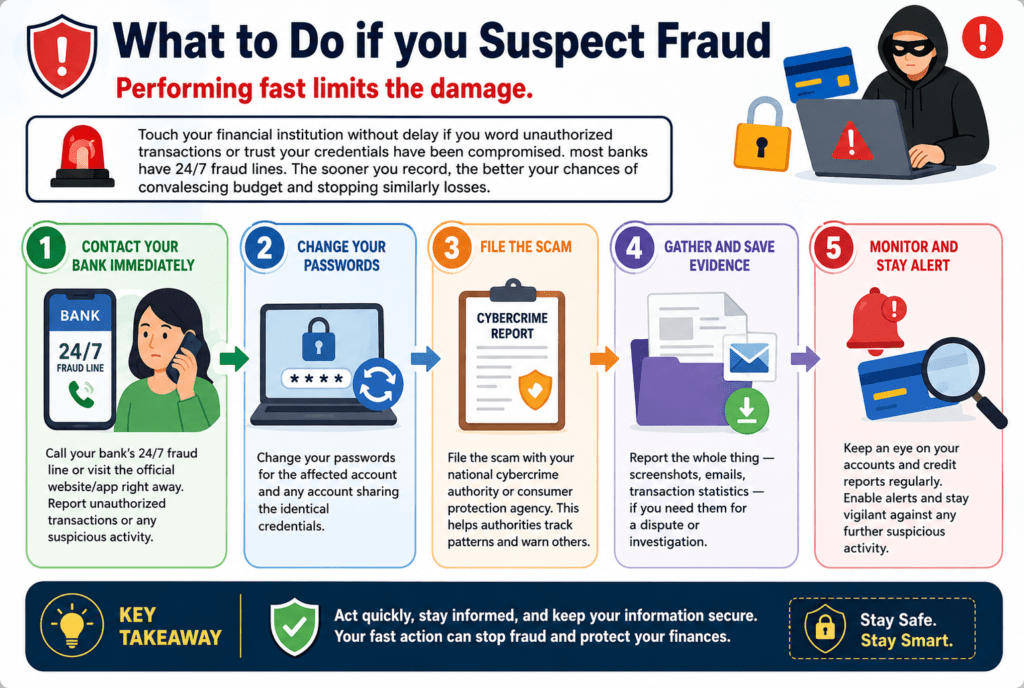
What to Do if You Suspect Fraud
Performing fast limits the damage.
Contact your financial institution without delay if you suspect unauthorized transactions or if your credentials have been compromised. Most banks have 24/7 fraud lines. The sooner you record, the better your chances of conserving budget and stopping losses similarly.
Change your passwords for the affected account and any account sharing the same credentials.
File the scam for your countrywide cybercrime authority or consumer safety agency. This helps authorities track patterns and warn others.
Report the whole thing — screenshots, emails, transaction statistics — if you need them for a dispute or investigation.
Conclusion
The excellent protection against online banking scams is a knowledgeable, skeptical mindset mixed with sturdy technical behavior. Criminals rely upon speed, emotion, and assumption. When you slow down, verify, and secure your bills systematically, you dispose of most of the leverage they want. Your financial institution account is worth protecting — and now you know how.