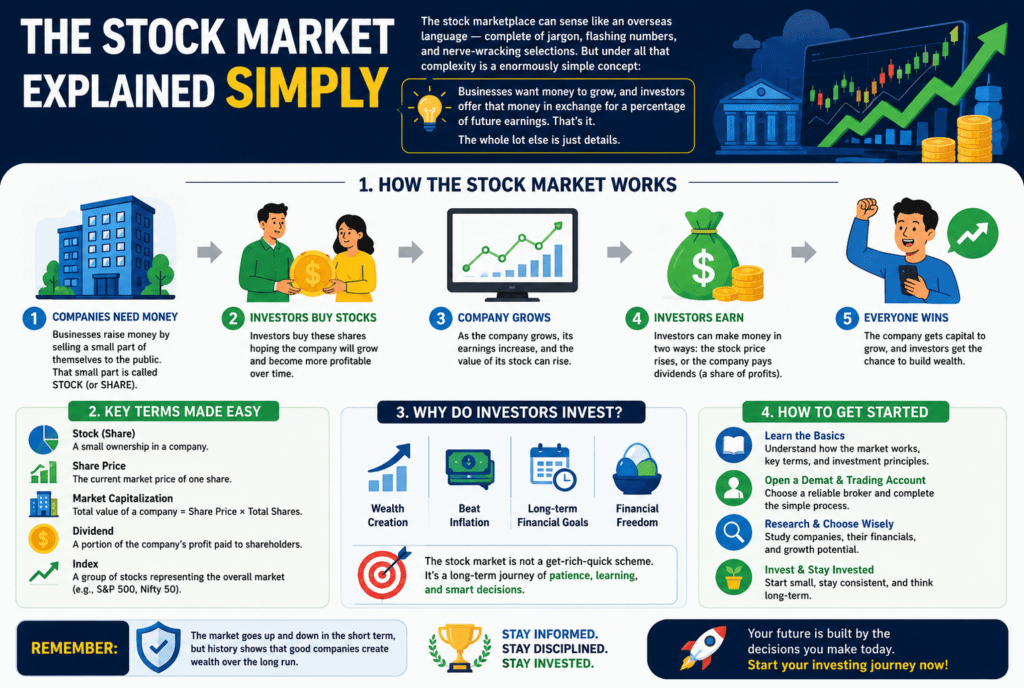
The stock market can seem like an overseas language — complete of jargon, flashing numbers, and nerve-wracking selections. But under all that complexity is an enormously simple concept: businesses want money to grow, and buyers offer that money in exchange for a percentage of destiny earnings. That’s it. The whole lot else is just details.
This manual cuts through the noise and walks you through exactly what you need to know to get started.
Understand what the stock marketplace certainly is
A stock represents a small ownership stake in a company. When you buy a proportion of an employer, you come to be a component-proprietor, entitled to a slice of its profits and property.
The inventory market is surely the market wherein these shares are bought and sold. In Pakistan, it’s the Pakistan Stock Exchange (PSX). Within the US, it’s the stock exchange (NYSE) or NASDAQ. These systems connect hundreds of thousands of consumers and dealers every unmarried day.
Whilst an agency does properly, demand for its stocks rises, and the price goes up. Whilst it struggles, the fee falls. Your activity as an investor is to buy stocks earlier than prices rise — and ideally hold them long enough to gain.
Analyze the important phrases
You don’t need an MBA to make investments, but some terms will appear continuously:
- Share/inventory — A unit of ownership in a corporation.
- Dividend — a part of a business enterprise’s profit paid out to shareholders, typically quarterly or annually.
- Portfolio — your entire collection of investments.
- Bull market — A period when inventory charges are growing. Buyers experience constructively.
- Bear market — A period during which inventory prices are falling. Pessimism dominates.
- Index — A benchmark that tracks a group of shares. The KSE-100 in Pakistan tracks the pinnacle 100 corporations at the PSX. The S&P 500 tracks 500 massive US companies.
- Broking — an authorized intermediary who executes your buy and sell orders.
- Market Capitalization (market capitalization) — the full price of a company’s stocks. Calculated by multiplying the proportion charge by means of the total range of shares.
When you’re relaxed with these, the financial information starts evolving, making lots more experience.
Set your economic goals
Before you make investments of a single rupee or dollar, get clear on why you’re investing. Your goals will shape each decision you’re making.
Ask yourself:
- What am I saving for? Retirement? A domestic? Financial independence?
- Whilst I will need this money? In 2 years or 20?
- How many dangers am I able to manage? May you sleep at night in case your portfolio dropped 30%?
If you want the money inside two or three years, the inventory marketplace won’t be suitable — quick-term fee swings can be brutal. But in case you’re making an investment for ten years or more, you’ve got time to experience out downturns and gain from long-term growth.
A trendy rule: invest cash you may not want in the short term.
Open a Brokerage Account
To buy stocks, you need a brokerage account — think of it like a bank account, but for investments.
While selecting a broker, consider:
- Costs and commissions — a few brokers charge in line with trade; others provide zero-commission buying and selling.
- Ease of use — mainly important for beginners. Look for smooth apps and educational assets.
- Regulation — makes sure the broking is licensed with the aid of the relevant authority (SECP in Pakistan, FINRA/SEC in the US).
In Pakistan, popular options consist of brokers registered with the PSX, including Arid Habib, AKD Securities, and JS Worldwide. Internationally, structures like Fidelity, Charles Schwab, or eToro are beginner-friendly.
as soon as your account is open and funded, you’re prepared to make investments.
Begin with the index price range
New buyers often make the mistake of looking to pick prevailing stocks immediately. That is incredibly hard — even expert fund managers regularly fail to overcome the market.
A smarter start line is the index price range or ETFs (exchange-traded funds). Those are collections of stocks that replicate a market index. When you buy one ETF, you immediately own tiny portions of dozens or hundreds of organizations.
Why index budget work for novices:
- Instantaneous diversification — your threat is unfolding across many companies.
- Low prices — No high-priced fund manager selecting stocks.
- Regular lengthy-period performance — historically, extensive index budgets have outperformed most actively managed price ranges through the years.
Think about it this way: in preference to betting on one horse, you are having a bet on the whole race. Someone will win — you do not have to bet on who.
Diversify Your Portfolio
The golden rule of making an investment is: do not place all your eggs in a single basket.
Diversification is spreading your cash throughout extraordinary styles of investments — extraordinary industries, specific corporations, and even one-of-a-kind asset classes like bonds or real property. While one zone drops (say, generation), some other zones would possibly hold consistent (like customer staples or healthcare).
A primary diverse portfolio for a newbie may appear to be:
- 60–70% in huge stock index finances
- 20–30% in bond finances (decrease threat, lower reward)
- 10% in region-specific funds or character stocks (if involved)
As you learn more and develop more at ease, you can alter this combination.
Think long-term and stay regular
The most important mistake beginners make is reacting emotionally to short-term market moves. Whilst costs drop, panic units in — and people promote at exactly the wrong moment. When prices surge, greed takes over — and those buy at the peak.
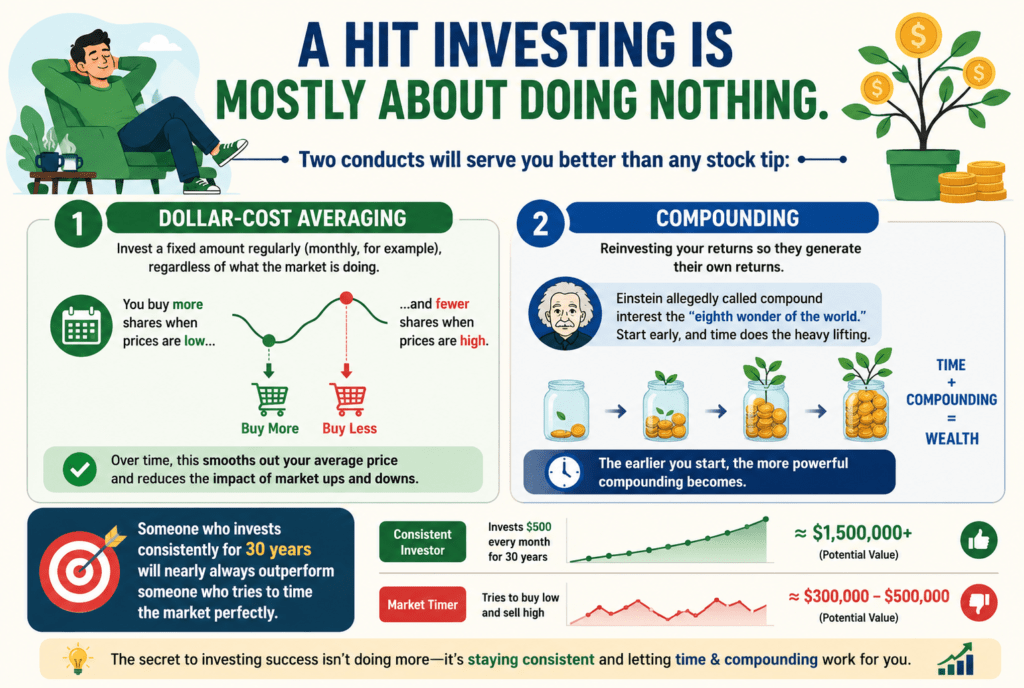
A hit investor is mostly about doing nothing.
Two conducts will serve you better than any stock tip:
Greenback-fee averaging — invest a hard and fast amount frequently (monthly, for example), irrespective of what the market is doing. You purchase extra stocks whilst expenses are low and less when they may be high. Over the years, this smooths out your common price.
Compounding — reinvesting your returns so that they generate their own returns. Einstein allegedly referred to the “eighth surprise of the sector.” Begin early, and time does the heavy lifting.
Someone who invests constantly for 30 years will nearly continually outperform someone who tries to time the marketplace flawlessly.
Conclusion
The stock marketplace rewards endurance, consistency, and clean thinking — not excitement or guesswork. Don’t want to be wealthy to begin. You do not need to understand each monetary instrument. You simply need to begin.
start small. Examine as you cross. Reinvest your returns. And face up to the urge to test your portfolio each hour.
The quality time to start making an investment changed ten years ago. The second exceptional time is nowadays.