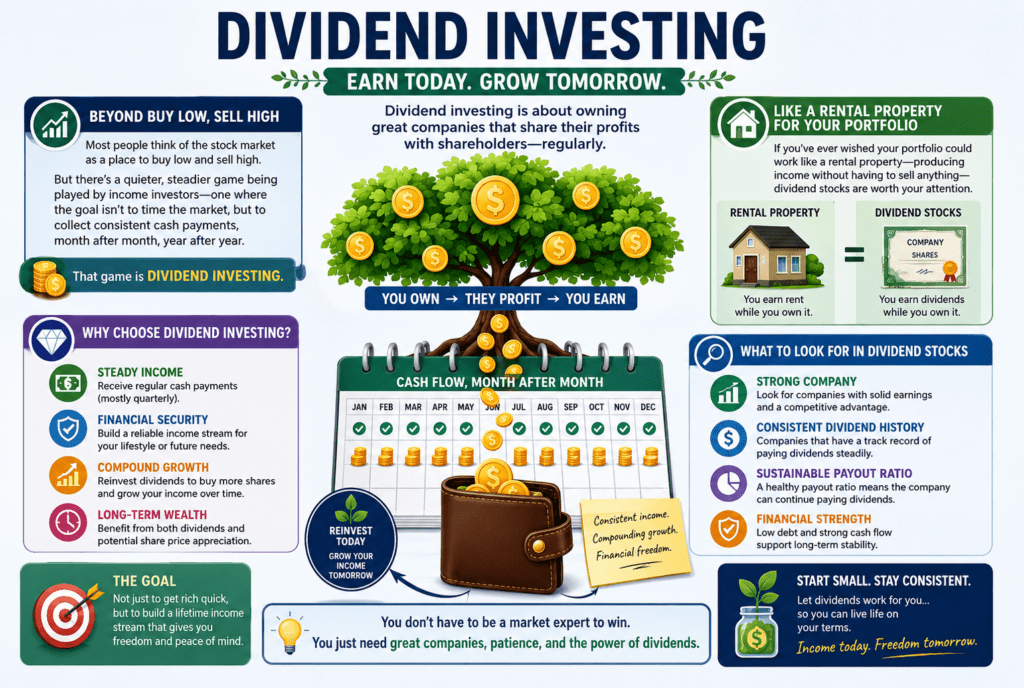
most of the people think about the stock market as an area to buy low and sell high. But there may be a quieter, steadier game being performed with the aid of profit traders — one where the purpose isn’t always to time the market. But to collect constant cash payments, month after month, year after 12 months. That recreation is a dividend, making an investment.
If you’ve ever wanted your portfolio to feature like rental belongings — producing earnings. While not having to promote something, dividend shares are well worth your attention.
What Are Dividend stocks?
A dividend is a portion of a company’s income paid out immediately to shareholders, generally on a quarterly basis. When you own dividend-paying shares, you obtain those payments as coins deposited into your brokerage account — no promotion required.
Now, not all shares pay dividends. Organizations that do are typically mature, financially strong businesses with predictable cash flows: assume utilities, purchaser staples, real property funding trusts (REITs). And large financial establishments. Those are companies that have moved beyond their high-boom phase and now return surplus coins to shareholders in preference to reinvesting them all.
The enchantment is straightforward: you preserve the stock. The corporation continues running its enterprise, and you collect a take a look at.
Why monthly profits, particularly?
Most dividend shares pay quarterly — 4 times a year. That’s high-quality for long-term wealth construction, but it’s less beneficial if you want your portfolio to cover monthly expenses like rent, utilities, or mortgage bills.
The coolest information: with the proper strategy, you could engineer a month-to-month income stream from dividend stocks — either with the aid of deciding on shares that already pay monthly or through impressive quarterly payers in order that payments arrive each month.
Monthly dividend payers encompass certain REITs (like Realty Income, which has branded itself “The month-to-month Dividend business enterprise”), commercial enterprise development companies (BDCs), and some closed-end funds. Those are motive-built for earnings traders who think in monthly coins glide.
Staggered quarterly payers provide greater flexibility. through preserving shares from groups with one-of-a-kind fee cycles — one group paying in January/April/July/October, any other in February/might also/August/November, and a third in March/June/September/December — you may construct a portfolio that obviously distributes income across every month of the year.
Key Metrics to assess before you buy
No longer is every dividend inventory well worth owning. High yield by myself isn’t a sign to shop for — in truth, strangely excessive yields (above eight–10%) frequently sign that the market expects the dividend to be cut. right here’s what to have a look at:
Dividend Yield is the annual dividend yield divided by the stock’s current price, expressed as a percentage. A yield among three% and 6% is an inexpensive target for maximum earnings buyers — high enough to generate significant income, low enough to signify the enterprise isn’t always overstretching.
Payout Ratio tells you what percentage of earnings the agency can pay out as dividends. A payout ratio beneath 75% usually indicates the dividend is sustainable. Anything above 90% (outside of REITs, which have different tax systems) warrants closer scrutiny.
Dividend boom records are arguably the most powerful indicator of dividend best. agencies which have continually raised their dividends for 10, 20, or maybe 50+ consecutive years — a group recognized informally as “Dividend Aristocrats” — have established the form of financial discipline that sustains long-term profits. Past will increase, do not assure future ones, but they are a robust sign of management’s priorities.
Unfastened cash flow is what actually finances dividends. An enterprise can post accounting income and still want to pay dividends if its cash glide is inconsistent. search for corporations producing greater loose coins go with the flow than they pay out.
Building Your Dividend Portfolio
Begin with diversification. Concentrating too closely in a unmarried region exposes you to quarter-specific shocks — in case you load up on electricity dividend stocks and oil costs crumble, your income takes the hit. Spread across sectors: utilities, healthcare, purchaser staples, financials, industrials, and REITs, each behaves in another way across economic cycles.
An easy framework for beginners: goal for 15–25 person holdings across five–7 sectors. This offers you enough diversification without making the portfolio unmanageable.
Dollar-value averaging — making an investment a set quantity on a regular timetable irrespective of price — reduces the danger of buying in at a top. It also keeps you out of the paralysis of looking to time the marketplace perfectly.
Dividend reinvestment (DRIP) is a powerful device at some point in your accumulation phase. Instead of taking dividend payments as cash, you reinvest them robotically to buy extra stocks. Over the years, these compounds your holdings and grow your future income quicker than cash contributions on my own.
Common errors to avoid
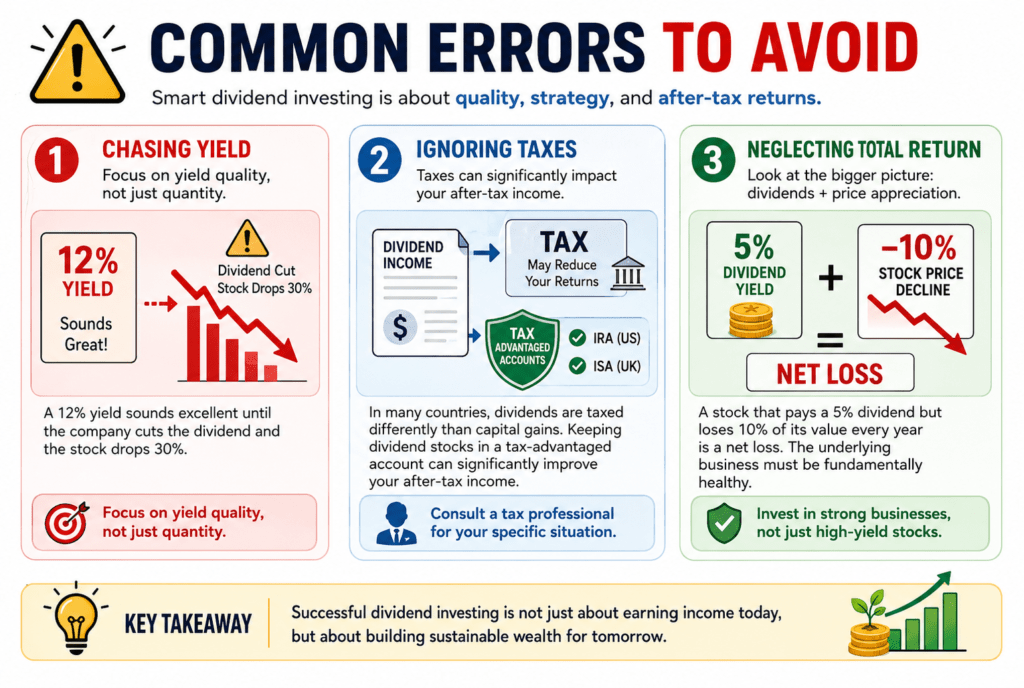
Chasing yield is the most not unusual lure. A 12% yield sounds exquisite until the corporation cuts the dividend and the inventory drops 30%. Focus on yield best, not just quantity.
Ignoring taxes is some other oversight. In many countries, dividends are taxed in a different way than capital profits. Keeping dividend stocks inside a tax-advantaged account (like an IRA inside the US, or an ISA in the United Kingdom) can notably improve your after-tax income. Seek advice from a tax consultant on your particular scenario.
Neglecting general go back is a subtler mistake. A stock that will pay a five% dividend but loses 10% of its fee every 12 months is an internet loss. The underlying enterprise wishes to be fundamentally healthy — dividend profits would not compensate for a deteriorating agency.
Conclusion
Permits are placed with numbers on them. In case you make investments $one hundred,000 in a dividend portfolio with a median yield of four %, you’ll generate $4,000 in line with year, kind of $333 consistent with month before taxes. Scale that to $500,000, and you are at $1,667, consistent with the month. These aren’t get-wealthy-brief figures; however, they constitute actual, passive profits constructed on a foundation of real enterprise profits.
The course to significant month-to-month dividend income is disciplined saving, a sensible choice, and time. It’s not glamorous. However, for investors who want income that doesn’t depend upon selling stocks or timing markets, it’s one of the most dependable techniques available.
Start small, stay consistent, and allow the dividends to compound. The monthly deposits — however modest before everything — have a manner of developing into something massive.