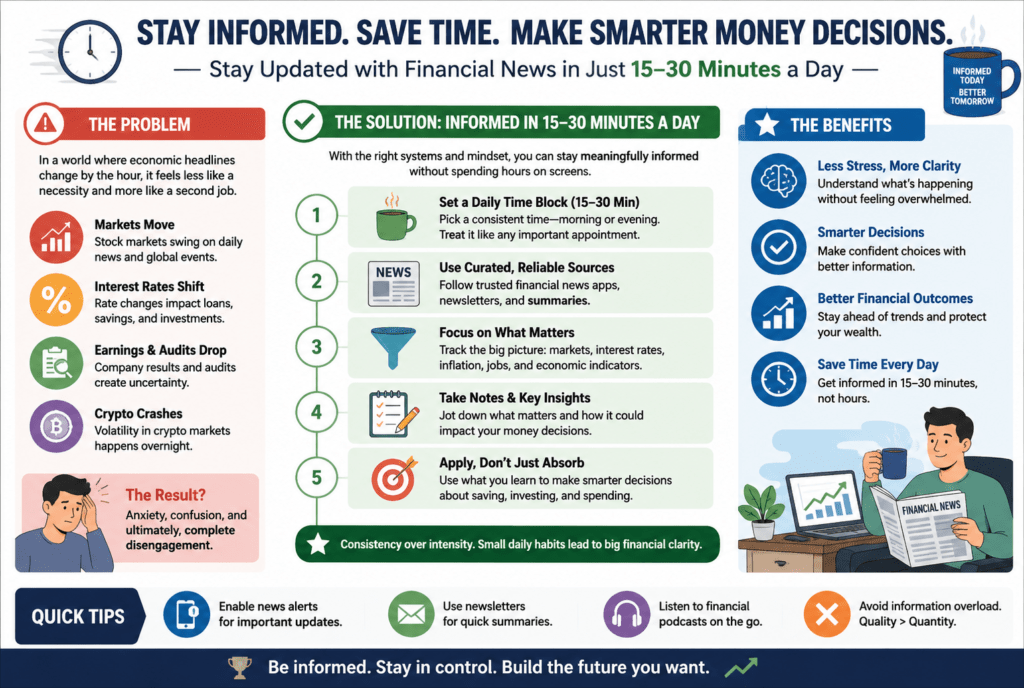
In an international environment where economic headlines trade with the aid of the hour, staying knowledgeable feels plenty less like a dependency and more like a 2d process. Markets pass, side interest rates move, swelling audits drop, and crypto crashes — all before you’ve completed your morning coffee. For the general public, the end result is not higher monetary decision-making. It’s anxiety, confusion, and ultimately, total disengagement.
The best information is that staying updated with economic news does not require spending hours glued to a screen. With the right systems and mindset, you could live meaningfully informed in only fifteen to thirty minutes a day — and make smarter money decisions due to it, not regardless of it.
Recognize why financial Overload takes place
Before building a better system, it enables to recognize why economic news feels so overwhelming at first sight.
The cutting-edge economic media enterprise is built around engagement, no longer education. Headlines are designed to cause emotional responses — fear, urgency, pleasure. “Showcase Crash Approaching,” “Why Your Money-Related Reserve Funds Are dropping charge,” and “The stock You need to purchase Presently” aren’t journalism; they may be clickbait wearing financial language.
Add to that the sheer quantity of content material: 24-hour financial information channels, loads of investing podcasts, daily newsletters, social media finance influencers, and real-time trading apps — all competing for your attention. The maximum of this content material is noise. After you accept that maximum economic news is beside the point on your personal state of affairs, filtering becomes a whole lot less complicated.
Outline what financial information really matters to you
The first step in constructing a sustainable information dependency is asking a simple however powerful question: what financial choices do I really want to make?
in case you’re a salaried employee with an extended-time period investment portfolio, each day inventory fee movements are in large part beside the point to you. in case you’re a small business proprietor, changes in hobby costs and tax policy depend a long way more than cryptocurrency headlines. in case you’re saving for a house, loan price traits and nearby real property records are your priority.
Write down the three to 5 economic areas maximum applicable in your existence right now. This becomes your filter-out. Any news that doesn’t touch one of those areas is non-obligatory studying at first-rate — history noise at worst.
This single mental shift — from ingesting the whole thing to ingesting what is relevant — removes most of the people of monetary weight without delay.
Build a “just sufficient” data eating regimen
As soon as you know what matters to you, construct a curated, minimum news weight loss plan around those topics.
Choose one or two trusted resources. In preference to scanning fifteen websites, pick out one widespread economic news source you agree with and one that’s unique for your place of interest. For well-known non-public finance publications such as the Wall Street Journal, Bloomberg, or maybe free alternatives like Investopedia news phase are reliable. For extra focused subjects, look for niche newsletters written by way of credible professionals instead of content farms.
Use newsletters over live feeds. Email newsletters are one of the most underrated tools for staying knowledgeable without being overwhelmed. A very good newsletter curates the week’s most critical financial news right into a five-minute read. You stay knowledgeable without the rabbit holes. Look for newsletters that post weekly rather than day by day — daily newsletters can quietly grow to be any other source of overload.
Set a devoted reading time. Don’t take a look at economic information reactively during the day. As an alternative, schedule a hard and fast time — fifteen mins in the morning or a thirty-minute catch-up on Sunday evenings. out of doors of that window, withstand the urge to check. Markets will nevertheless be there after lunch.
Use RSS readers or aggregators. Tools like Feedly or Flipboard let you pull articles from more than one asset into one smooth feed, filtered through subject matter. Instead of journeying to ten sites, you experiment with one. This protects time and reduces the temptation to click through two unrelated testimonies.
Distinguish between information and Noise
No longer is all financial content created the same. Gaining knowledge of how to split the signal from the noise is an ability that becomes sharper with practice.
Information that surely subjects tend to involve coverage adjustments (hobby charge selections, tax law updates, regulatory shifts), macroeconomic statistics (inflation reviews, employment figures, GDP growth), and structural market adjustments (enterprise disruptions, principal corporate collapses, foreign money movements in nations relevant to your budget).
Noise, however, is basically a short-term rate hypothesis, opinion pieces dressed as analysis, and sensational predictions about market crashes or explosive booms. If a headline makes you feel panicked or euphoric, treat it with extra skepticism. Emotional monetary content is nearly always designed to power clicks, not inform decisions.
A useful rule of thumb: if the information would not exchange what you plan to do together with your cash inside the next six to three hundred and sixty-five days, it in all likelihood would not deserve more than a glance.
Use generation wisely
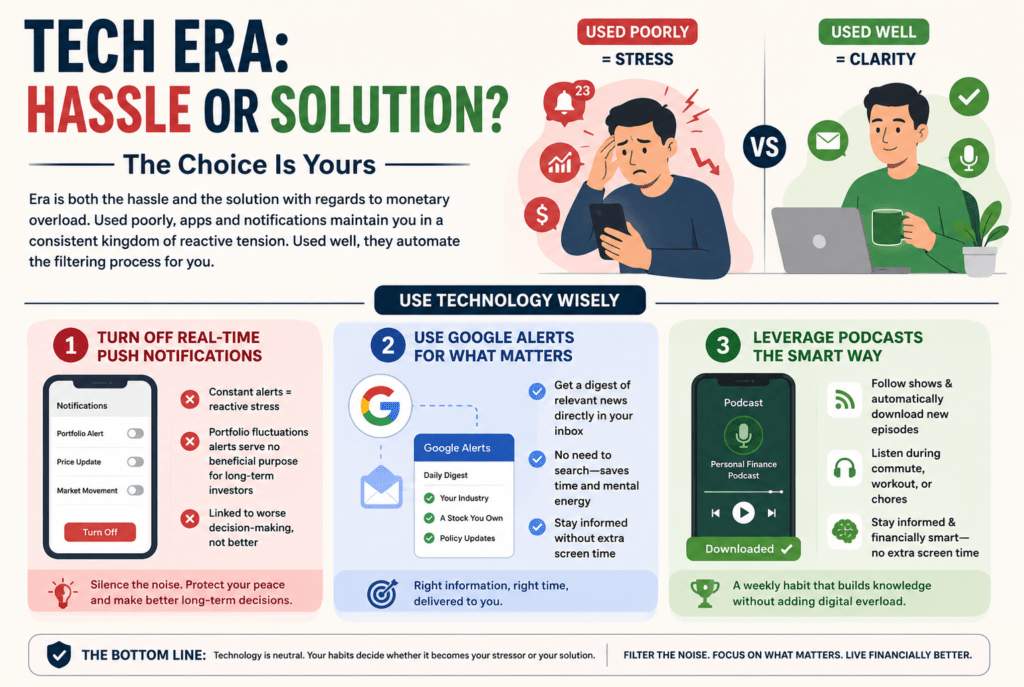
Era is both the hassle and the solution with regard to monetary overload. Used poorly, apps and notifications keep you in a consistent kingdom of reactive tension. Used well, they automate the filtering process for you.
Turn off real-time push notifications from financial apps until you are an active trader who really wishes them. Regular alerts about portfolio fluctuations serve no beneficial purpose for long-term buyers and were linked to worse decision-making, not better.
Alternatively, install Google alerts for particular topics — your enterprise, an inventory you own, or a coverage area applicable to your finances. You’ll get hold of a digest of applicable news at once for your inbox, without having to search for it.
Podcast apps additionally permit you to follow shows and download new episodes automatically. An unmarried weekly non-public finance podcast, listened to at some point of your commute or exercise, can keep you well-informed without requiring any greater display time.
Take delivery of that you won’t recognize the whole lot — and that’s best
Perhaps the most crucial intellectual adjustment is accepting that you may usually omit some financial news. Markets flow. Events occur. Headlines come and go. it really is no longer a failure of your facts gadget. It truly is simply reality.
The investors and economic choice-makers who consistently do well are hardly ever those with the most facts. They may be those with the clearest method, the most powerful basics, and the ability to stay calm whilst noise reaches a height.
Staying up to date with economic news is not about ingesting more. It is approximately eating smarter. Define what subjects you, build a lean, curated statistics diet, set barriers around your analyzing time, and allow the rest to cross.
Your economic future will be shaped far more by using regular, disciplined choices than by using whether or not you caught the present-day marketplace headline the moment it broke. live informed, live calm, and stay centered on what clearly moves the needle in your personal financial lifestyles.